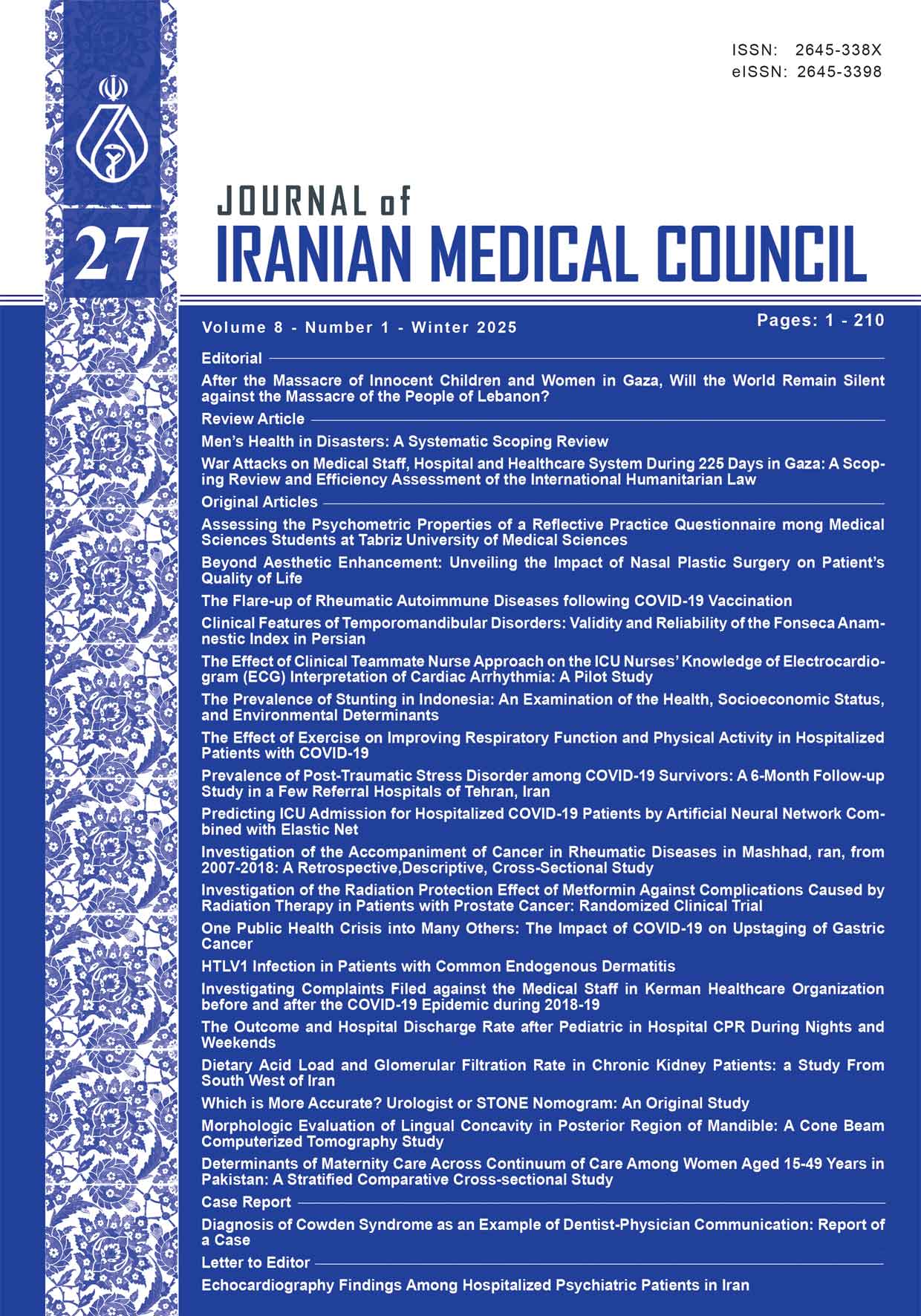
Document Type : Original article
Introduction
Nasal obstruction is one of the main reasons for otorhinolaryngology visits. Besides nasal obstruction, some patients seek surgery for aesthetic reasons or both beauty and nasal obstruction. Therefore, septorhinoplasty has become one of the most common operations of facial plastic surgeons to improve nasal appearance and aesthetic harmonization and to treat nasal obstruction (1).
Research about the outcome of septorhinoplasty is still a controversial issue. Evaluation of the patient’s satisfaction with functional and aesthetic points and possible effects of these factors on each other are among other debatable topics. Because most self- assessment reports are subjective, and the patient’s quality of life is very important.
Many studies have discussed the indications of this kind of cosmetic surgery and also the advantages and disadvantage of the procedure with different criteria like Montgomery Asberg Depression Rating Scale (MADRS), Social Interaction Self-Statement Test (SISST), and EuroQol-5D (EQ 5D) (1). Some studies have shown how this surgery can improve the patient’s attractiveness and satisfaction of using the visual analog scale (2), appearance schemes inventory (3), body image avoidance questionnaire (4), and body dysmorphic disorder examination (5).
Subjective assessment of the Quality of Life (QOL) as an important aspect of outcome research has received increasing importance during the past decades. QOL is measured with standardized questionnaires which have been tested with regard to reliability, validity, and sensitivity (6-8).
There are a limited number of methods for evaluating the patient’s outcome post septorhinoplasty. In this study, two standard and qualified questionnaires, including the Rhinoplasty Outcome Evaluation (ROE) and Nasal Obstruction and Septoplasty Effectiveness Scale (NOSE) questionnaires, and also Visual Analogue Scale (VAS) were used to assess the patient’s satisfaction, QOL, and functional outcomes like resolution of nasal obstruction specifically in those who had nasal obstruction before surgery.
Materials and Methods
Study subjects
Seventy-two patients participated in this study from December 2015 to December 2017. Inclusion criteria were the patients who came for septorhinoplasty to the facial plastic department. Exclusion criteria were previous external rhinoplasty or septorhinoplasty, congenital malformations, or a history of any systemic disease (diabetes and other hormonal diseases, collagen vascular diseases, immune deficiency disorders, etc.) However, none of the patients had systemic diseases. The follow up period was one year. All patients completed the study follow-up.
Ethical approval
The protocol of this study was approved by the Institutional Review Board of Tehran University of Medical Sciences. Detailed information about the study was given to the participants and a written informed consent was obtained from each one. All aspects of the study were conducted according to the Declaration of Helsinki.
Type of procedures and medical treatment
The authors used an external incision septorhinoplasty approach in all cases. All procedures were performed by one of the senior authors under general anesthesia. Additionally, an internal lateral osteotomy was performed in all procedures. All patients received 8 mg Dexamethasone during anesthesia. No packing was used. Moreover, antibiotic prophylaxis (Cephalexin 500 mg/QID for five days) was given to all patients and the only prescribed analgesic was Acetaminophen. Subsequently, their nasal splints were removed after 7 days, but tapings were continued for 4 weeks thereafter.
Outcome evaluation
Besides patients’ baseline characteristics, the septorhinoplasty outcome was evaluated with ROE, NOSE and VAS questionnaire. ROE questionnaire evaluates both satisfaction of cosmetic outcome and functional outcome (9). NOSE questionnaire (which is a 5-task questionnaire about nasal function) shows the patient’s nasal function (10). Patients with NOSE score of 30 or more were considered as “case with obstruction” and less than 30 score as “patients without obstruction’. VAS was also reported by patients (0= worse nasal functional status and 10= the best status).
Statistical method
Data were analyzed using SPSS 18 (IBM Corp., Armonk, NY, USA). Kolmogorov-Smirnov test was applied for postoperative variables, which showed they did not follow a normal distribution; therefore, non-parametric tests were used.
The Chi-square test was used to evaluate the preoperative sex ratio in each group and T-test and paired T-Test were used for the rest of the variables. Moreover, the Mann- Whitney test and ANOVA were used in this series. Values were evaluated using descriptive statistical methods (mean±SD) and results were significant at p≤0.05.
Results
Seventy-two patients who were candidates for septorhinoplasty participated in this study based on the inclusion and exclusion criteria. The mean age of the patients was 28.59 years (range: 18-45 years). There were 57 (79.17%) women and 15 (20.83%) men in this study.
One of the variables was septorhinoplasty outcome measured by the ROE questionnaire. The results are summarized in table 1. This questionnaire is used to evaluate satisfaction with both the cosmetic and functional outcome. The results showed that the mean ROE score was 10.4±-3.0 (range: 3-17) before and 19.8±3.7 (range: 9-24) 12 months after septorhinoplasty. The ROE score increased in 71 patients and had no change in one patient, indicating a significant difference (p-value <0.001).
Another variable was functional outcome after septorhinoplasty that was evaluated using the NOSE questionnaire (Table 2). In this study, 29 (40.3%) patients had and 43 (59.7%) did not have nasal obstruction before surgery. This questionnaire was analyzed based on gender, age and education, and only gender had a significant effect on the results (p- value <0.05). In general, after septorhinoplasty, all patients reported nasal function improvement. This improvement was more prominent and significant in men (from 48.66±32.97 to 20.00±17.21, p-value <0.001).
The results of the VAS showed an overall significant improvement in the nasal obstruction after surgery (p-value: 0.006); however, according to sex, this improvement was not significant in women (p-value: 0.129). Moreover, the patients who complained about nasal obstruction before surgery showed a marked improvement in NOSE (from 60.51±22.53 before surgery to 26.03±18.29 after surgery, p<0.0001) and VAS (from 6.43 to 3.25, p<0.0001) after surgery. Patients with no complaints about nasal function experienced a significant improvement in NOSE (from 11.04+13.73 to 5023+6.98, p: 0.001), while their VAS score did not change significantly (p: 0.076).
Table 1. ROE result before and after surgery
|
ROE |
Mean ±SD |
p-value |
|
Total score before surgery |
10.4±3.0 |
<0.001 |
|
Total score after surgery |
19.8±3.7 |
|
|
How well do you like the appearance of your nose? Baseline |
1.28±0.89 |
0.288 |
|
How well do you like the appearance of your nose? After surgery |
3.21±0.78 |
|
|
How well are you able to breathe through your nose? baseline |
2.83±1.30 |
<0.001 |
|
How well are you able to breathe through your nose? after surgery |
3.0±1.10 |
|
|
How much do you feel your friends and loved ones like your nose? Baseline |
1.74±0.94 |
<0.001 |
|
How much do you feel your friends and loved ones like your nose? after surgery |
3.38±0.65 |
|
|
Do you think your current nasal appearance limits your social or professional activities? base line |
3.19±1.07 |
<0.001 |
|
Do you think your current nasal appearance limits your social or professional activities? after surgery |
3.97±0.16 |
|
|
How confident are you that your nasal appearance is the best that it can be? base line |
1.06±0.93 |
<0.001 |
|
How confident are you that your nasal appearance is the best that it can be? after surgery |
3.10±0.99 |
|
|
Would you like to surgically alter the appearance or function of your nose? base line |
0.39±0.54 |
< 0.001 |
|
Would you like to surgically alter the appearance or function of your nose? after surgery |
3.32±1.18 |
Table 2. NOSE score before and after surgery
|
NOSE |
Mean±SD |
p-value |
|
Baseline |
27.50±31.21 |
0.002 |
|
After 12 months |
17.08±17.27 |
|
|
NOSE (with obstruction) |
Mean±SD |
p-value |
|
Baseline |
60.51±22.53 |
< 0.001 |
|
After 12 months |
26.03±18.29 |
|
|
NOSE (without obstruction) |
Mean±SD |
p-value |
|
Baseline |
5.23±6.98 |
0.011 |
|
After 12 months |
11.04±13.73 |
|
Discussion
Rhinoplasty, as a common plastic surgery procedure, may affect self-confidence, resulting in higher QOL and resolving obstruction if it does exist. Many studies have discussed the goals of this surgery as a desire for a better appearance, better self-confidence, and better social interaction (1). Some studies have reported normalization of the appearance and aesthetic harmonization in deformed and deviated noses as the objectives of rhinoplasty (2), but there are patients who are not satisfied with cosmetic or functional results. In one study, many septorhinoplasty applicants had some degrees of depression, anxiety (not clinically significant), and body dysmorphic disorder (11).
During the past decades, assessment of the QOL has been an important head title in research, especially before and after cosmetic surgery, using standardized, reliable, and valid questionnaires. Cosmetic surgery of the nose is one of the most common cosmetic operations in recent years, but the QOL of the patients has been infrequently assessed and compared before and after surgery. Therefore, 72 septorhinoplasty patients were included in this study and their outcomes evaluated before and 12 months after the surgery.
The majority of study patients were women (79%), indicating their preference to undergo this surgery. However, the proportion of men (20.8%) was also remarkable, showing the increased popularity of this surgery with men.
Three scales were used to evaluate the outcome of rhinoplasty: NOSE and VAS (for assessment of nasal function), and ROE (for assessment of nasal function as well as rhinoplasty-related patient satisfaction).
Some studies have used the NOSE questionnaire as a good tool for measuring the quality of life (12). Therefore, like some other studies, the significant decrease in the NOSE score in this study can be considered a sign of QOL improvement in these patients (10,13,14). Moreover, the change of the nasal function was analyzed separately for the patients who had and did not have complaints about nasal obstruction before surgery.
In a study by Lipan et al in 2013, the NOSE questionnaire was applied to measure the severity of nasal obstruction in 345 patients who were candidates for septorhinoplasty. The patients were divided to three groups of mild (a score of 5-25), moderate (a score of 30-50), severe (a score of 55 to 75) and very severe (a score of 80 to 100) obstruction (15). According to the results, 29 patients (40.3%) scored 30 or higher, indicating obstruction and 43 patients scored below 30, indicating lack of obstruction.
A significant improvement in the NOSE score, especially in those who had complaints about nasal obstruction before surgery (from 60.51 to 26.03 which means a change from severe obstruction to lower limit of moderate obstruction), shows the probability of higher satisfaction in these patients after surgery. Moreover, male sex was an independent factor for a significant improvement in obstruction. This reason for this gender difference may be that nasal obstruction in men is mainly caused by nasal trauma and fracture, which can be effectively corrected surgically. As a result, the NOSE and VAS indicated a significant improvement in men after surgery.
A significant improvement in ROE score from 10.4±-3 to 19.8±3.7 one year after surgery showed satisfaction with this kind of cosmetic surgery both for aesthetic and facial outcomes, indicating a higher QOL (16). In a study by Faidiga et al in 2010, the ROE score improved by 73.25% (17), and another study by Younes et al showed a significant improvement from 43.3 to 76.95 using the ROE questionnaire (12). A significant improvement in the QOL has also been shown in some other studies using other test like MADRS, SISST, EQ 5D (18), and DAS59 (1). In one study by Cingi C et al in 2011, both male and female patients experienced significant improvement in ROE scores, with larger differences between pre- and postoperative ROE scores in male patients (19).
There are limited articles about the role of different nasal pathologies on patient satisfaction and improvement in QOL, but several QOL studies in rhinoplasty. Lima Ramos et al (20) determined higher depression scores in patients with deviated nose deformity and emphasized that deviation of external nose may cause a negative impact on QOL, but in this study men (which overall had more nasal obstruction and deviated nose) had more significant improvement in NOSE and VAS criteria. So, the difference of this study with Lima Romas et al study may be because gender was considered as an independent factor for outcome of rhinoplasty. In addition, Arima et al (21) evaluated the outcome of rhinoplasty in a limited number of patients with crooked nose (only 19 patients). They reported that most of the patients were satisfied from the surgical result. In another study by Cingi and Eskiizmir, the satisfaction and QOL in patients with non-deviated and deviated nose deformity were examined and compared and they demonstrated relatively lower patient satisfaction and improvement in QOL in patients with deviated nose deformity, even though almost all of the patients with deviated nose deformity had better postoperative scores (22,23). In a sociological study conducted on the candidates of rhinoplasty showed that these patients were perfectionistic about themselves (24). Therefore, it seems further study must be conducted to consider both gender, severity of deformity and also personal perception and emotional status before surgery independently to show more accurate results.
Conclusion
The results of this study showed higher satisfaction with cosmetic results and nose appearance, higher quality of life both in family relationships and social communications (regardless of gender), and also a better feeling of nasal air flow and resolution of nasal symptoms, especially in men who had more complaints about nasal symptoms.
Conflict of Interest
The authors declared no conflict of interest.