Introduction
Tuberculosis (TB) is a contagious bacterial disease caused by an airborne bacterium Mycobacterium tuberculosis. It mostly attacks the lungs (pulmonary TB) but can affect any organ in the body, that is, extra Pulmonary TB (1). Despite being preventable and treatable, TB remains a deadly disease. According to the global report from the Centers for Disease Control and Prevention (CDC), one-fourth of the world’s population (two billion people) may be infected with TB, with 10.6 million becoming ill each year. Globally, over 3,500 individuals lose their lives to TB each day, totaling 1.3 million deaths each year with Nigeria ranked as the sixth country with the highest burden (2,3). However, Drug-Resistant Tuberculosis (DR-TB) remains a major public health concern, with an estimated 19 million people suffering from multidrug-resistant tuberculosis (MDR-TB) infection (4,5). As reported by the World Health Organization (WHO), there are more than one million rifampicin-susceptible and isoniazid-resistant TB cases annually. Additionally, 3.3% of new cases and 17% of previously treated cases involve Multi Drug Resistant TB (MDR-TB) and Rifampicin-Resistant TB (RR-TB), representing 410,000 cases and resulting in 160,000 deaths each year (6,7) TB was the world’s second leading cause of death from a single infectious agent, after coro-navirus disease (COVID-19). As a result, multidrug-resistant TB is contributing to the undesirable increase in TB morbidity and mortality (8).
Drug-resistant TB (DR-TB) comes in various forms, such as mono-resistant tuberculosis and MDR-TB. The former refers to TB resistant to any single first-line anti-tuberculosis drug, while the latter is resistant to key first-line anti-tuberculosis drugs, rifampicin, and isoniazid (9). Poly-resistant tuberculosis is resistant to more than one first-line drug, excluding rifampicin and isoniazid. When MDR-TB is not adequately treated due to various health system challenges in developing countries, it can progress to extensively drug-resistant TB (XDR-TB). Extensively resistant tuberculosis (XDR-TB) involves MDR-TB and additional resistance to any fluoroquinolone and second-line injectable drugs, such as Amikacin, Kanamycin, or Capreomycin (10) bacteriologic, and weight from 439 MDR-TB patients in the Philippines. development presents a major challenge to tuberculosis prevention and control, especially in developing countries like Nigeria (11,12). MDR-TB treatment is commonly linked with unsuccessful outcomes compared to non-MDR-TB therapy (13). However, socio-demographic characteristics such as age, sex, place of residence, occupation, marital status, and HIV co-morbidity are the known predictors of favorable treatment outcomes according to the study conducted in 2020 (14) treatment, prevention and rehabilitation requires frequent update of existing guidelines. This review is aimed at providing clinicians and public health staff with an updated and easy-to-consult document arising from consensus of Global Tuberculosis Network (GTN).
To capture the susceptibility pattern of all available anti-tuberculosis drugs used to treat the infection, bacteriological analysis for MDR-TB requires utilizing the molecular tests like the Xpert MTB/RIF assay to detect resistance patterns or other rapid Drug Sensitivity Tests (DST) (5). This study aims aimed at identifying the predictors of unfavorable treatment outcomes among the enrollees with MDR-TB in Osun State. The study’s results will therefore add to the general field of knowledge and will be useful in developing the policies aimed at improving the treatment outcomes among MDR-TB patients.
Materials and Methods
Study design and participants
This research employed a retrospective study design. A total of 201 clients from Osun State, Nigeria, between 2015 and 2020 were enrolled. Among these, 20 clients were excluded due to incomplete documentation. The treatment regimen administered was standardized and comprised Fluoroquinolones (such as moxifloxacin and levofloxacin), injectable agents (like amikacin, kanamycin, or capreomycin), and Group 4 and 5 drugs (including ethionamide, prothionamide, cycloserine, linezolid, bedaquiline, and clofazimine). This regimen remained consistent throughout the study period. And all the patients had completed their treatment before the survey commenced.
Research tools or measurements
Data collection was performed using a proforma. Data was obtained from the records of clients enrolled in the tuberculosis program in Osun State, selecting only those with complete documentation. The proforma consisted of four sections: background demographic information, baseline clinical parameters, baseline laboratory parameters, and categorized treatment outcomes based on World Health Organization (WHO) definitions.
Statistical analysis
Following the data collection, the data were cleaned to check for errors and omissions before being analyzed using the Statistical Package for Social Sciences (SPSS), version 26. Records from 181 clients were analyzed, and univariate analysis was performed, with categorical variables expressed as frequencies and percentages. For the continuous variables, summary measures were used. The bivariate analysis employed the chi-square test to examine the relationships between categorical variables (independent variables: socio-demographic status, categorized drug intake, categorized baseline clinical profile, and categorized baseline laboratory profile) and treatment outcomes (dependent variable). Finally, a binary logistic regression analysis was conducted to identify the predictors of favorable treatment outcomes among the clients, using variables that were significant in the bivariate analysis. The p-value was set at 0.05 (95% confidence interval).
Ethical considerations
Ethical approval for the study was obtained from the Health Research Ethics Committee at the College of Health Sciences, Osun State University, Osogbo (UNIOSUNHREC 2021/PBH/017). Additionally, approvals were granted by the Osun State Tuberculosis and Leprosy Control Program and the Osun State Ministry of Health, Osogbo. The confidentiality of clients’ information was ensured by not recording any names.
Results
Table 1 shows the socio-demographic characteristics of the study subjects (n=181). The age with the highest percentage was the age group 30-39 years (26.5%). More than half (58.6%) of the clients were male while two-thirds (69.6%) were married.
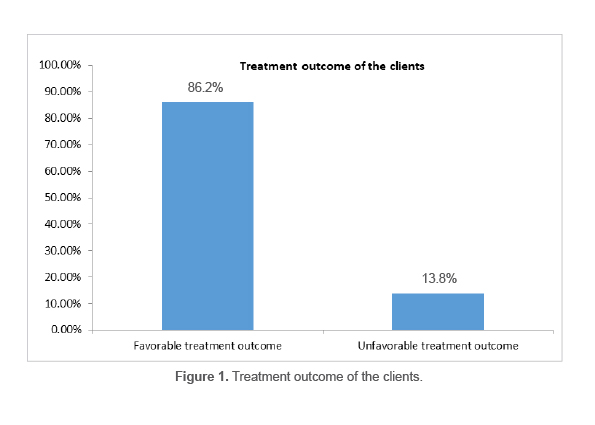
The treatment outcome of the clients showed that the majority (86.2%) of them had a favorable (cured, treatment completed) treatment outcome (Figure 1).
Table 2 illustrates that all the clients had their site of disease to be pulmonary, 41.4% were new cases of MDR-TB and more than half (54.7%) were underweight. Also, all the clients were detected to be RIF resistant and the majority (88.4%) tested negative for HIV. Half (50.3%) of the clients were tested to be negative for rifampicin resistance when tested by Sputum Acid-Fast Bacilli (AFB). When tested by sputum culture, more than half (57.5%) were tested negative for rifampicin resistance, and almost all the clients (92.8%) were discovered to be anemic when their hemoglobin was tested. The fasting blood sugar of the majority (70.7%) of the clients was normal. As for the renal function test, the potassium (K+) and serum urea levels are normal in more than half (54.7, and 58.6% respectively) of the clients, and sodium (Na+) is normal in the majority (84.5%). Also, serum creatinine is normal in two-thirds of the clients. The test for ALT, AST, Albumin, and Bilirubin (Liver function test) is normal among the majority (86.7%, 92.3, 80.1%, and 84.5%) of the clients.
Table 3 shows that there is no association between the socio-demographic characteristics of the clients and treatment outcomes. However, an association exists between drug intake and treatment outcome (p=0.001, X2–10.583) while there is no association between the baseline clinical parameters and treatment outcome.
Table 4 below shows that the only baseline laboratory profile that has a significant association with the patients’ treatment outcome was the hemoglobin level of the patients and their treatment outcome (p= 0.045, X2–2.245).
Table 5, clients with adherence to drug intake are 4.3 times more likely to have a favorable outcome compared to clients with non-adherence to drug intake (OR 4.3, CI -1.74 to 10.75).
Explanation of the results: Clinically, the majority had pulmonary MDR-TB-181(100.0%), a new type of DRTB 75(41.4%), and were under-weight 89(49.2%). Concerning the laboratory profile, almost all (92.8%) were anemic, more than four-fifths of clients, 156(86.2%) had a favorable treatment outcome (cured and treatment completed) while 25(13.8%) had an unfavorable treatment outcome. There was an association between drug intake (second-line drugs) and treatment outcome (p=0.001, X2–10.583) as well as hemoglobin status (p=0.045, X2 – 2.245).
Table I. Socio-demographic characteristics (n=181)
|
Variables
|
Sub-variables
|
Frequency
|
Percentage (%)
|
|
Age in categories
|
0-9 years
|
2
|
1.1
|
|
10-19 years
|
11
|
6.1
|
|
20-29 years
|
42
|
23.2
|
|
30-39 years
|
48
|
26.5
|
|
40-49 years
|
43
|
23.8
|
|
≥50 years
|
35
|
19.3
|
|
Sex
|
Male
|
106
|
58.6
|
|
Female
|
75
|
41.4
|
|
Marital status
|
Single
|
53
|
29.3
|
|
Married
|
126
|
69.6
|
|
Widowed
|
2
|
1.1
|
Table 2. Clinical profile of clients, baseline laboratory profile
|
Variables
|
Sub-variables
|
Frequency
|
Percentage (%)
|
|
Site of the disease
|
Pulmonary
|
181
|
100
|
|
Extra-Pulmonary
|
0
|
0
|
|
Both
|
0
|
0
|
|
Type of DR TB
|
New
|
75
|
41.4
|
|
Relapse
|
41
|
22.7
|
|
Treatment after failure
|
37
|
20.4
|
|
Treatment after loss to follow up
|
19
|
10.5
|
|
Patient with unknown previous TB treatment history
|
1
|
0.6
|
|
Transferred in from another DRTB treatment center
|
2
|
1.1
|
|
Others previously treated
|
6
|
3.3
|
|
Baseline Body Mass Index (BMI)
|
Underweight (Less than 18.5 kg/m2)
|
99
|
54.7
|
|
Normal (18.5-24.9 kg/m2)
|
64
|
35.4
|
|
Overweight (25-29.9 kg/m2)
|
10
|
5.5
|
|
Obese (30-39.9 kg/m2)
|
8
|
4.4
|
|
Very obese (>40 kg/m2)
|
0
|
0
|
|
Gene Xpert
|
Rif resistance detected
|
181
|
100
|
|
Rif resistance not detected
|
0
|
0
|
|
HIV Test Result
|
Not done
|
0
|
0
|
|
Positive
|
18
|
9.9
|
|
Negative
|
160
|
88.4
|
|
Unknown
|
3
|
1.7
|
|
Sputum AFB
|
Positive
|
90
|
49.7
|
|
Negative
|
91
|
50.3
|
|
Sputum culture
|
Positive
|
77
|
42.5
|
|
Negative
|
104
|
57.5
|
|
Fasting blood sugar
|
Normal
|
128
|
70.7
|
|
Impaired glucose tolerance
|
46
|
25.4
|
|
Diabetics
|
7
|
3.9
|
|
Hemoglobin
|
Normal
|
13
|
7.2
|
|
|
Anemic
|
168
|
92.8
|
|
Renal function test
|
|
(K+)
|
Normal (3.5-5 mmol/L)
|
99
|
54.7
|
|
|
Abnormal (<3.5 mmol/L & >5 mmol/L)
|
82
|
45.3
|
|
(Na+)
|
Normal (120-140)
|
153
|
84.5
|
|
|
Abnormal (<120 & >140)
|
28
|
15.5
|
|
(Serum urea)
|
Normal (6-24 mg/dl)/(2.1-8.5 mmol/dl)
|
106
|
58.6
|
|
|
Abnormal
(<6 mg/dl & >24 mg/dl)/(2.1 mmol/L & 8.5 mmol/L)
|
75
|
41.4
|
|
(Serum Creatinine)
|
Normal
Men (0.74-1.35 mg/dl)/(65.4-119.3 mmol/L)
Women (0.59-1.04 mg/dl)/(52.2-91.9 mmol/L)
|
120
|
66.3
|
|
Abnormal
Men (<0.74 mg/dl & >1.35 mg/dl)/(<65.4 mmol/L & >119.3 mmol/L)
Women (<0.59 mg/dl & >1.04 mg/dl)/(<52.2 mmol/L & >91.9 mmol/L)
|
61
|
33.7
|
|
Liver function test
|
|
ALT [_up to 56 _]
|
Normal (7-56)
|
157
|
86.7
|
|
Deranged (<7 or>56)
|
24
|
13.3
|
|
AST [_up to 40_]
|
Normal (5-40)
|
167
|
92.3
|
|
Deranged (<5 or>40)
|
14
|
7.7
|
|
Albumin [_less than 35_]
|
Normal (3.4-5.4 g/dl)/(34-54 g/L)
|
145
|
80.1
|
|
Abnormal (<3.4 g/dl or >5.4 g/dl)/(<34 g/L or >54 g/L)
|
36
|
19.9
|
|
Bilirubin
|
Normal (0.2-1 mg/dl)
|
153
|
84.5
|
|
|
Abnormal (<0.2 mg/dl & >1 mg/dl)
|
28
|
15.5
|
Table 3. The association between socio-demographic status, drug intake and baseline clinical parameters, and treatment outcome
|
Variables
|
Sub-variable
|
Treatment
outcome
|
df
|
Statistics (x2),(p)
|
|
|
|
Favorable
|
Unfavorable
|
|
|
|
Sex
|
Male
|
95(89.6%)
|
11(10.4%)
|
1
|
X2=2.535
p=0.111
|
|
Female
|
61(81.3%)
|
14(18.7%)
|
|
Age
|
0-9
|
2(100.0%)
|
0(0.0%)
|
5
|
X2=5.300
p=0.380
|
|
10-19
|
10(90.9%)
|
1(9.1%)
|
|
20-29
|
35(83.3%)
|
7(16.7%)
|
|
30-39
|
40(83.3%)
|
8(16.7%)
|
|
40-49
|
41(95.3%)
|
2(4.7%)
|
|
50 and above
|
28(80.0%)
|
7(20.0%)
|
|
Marital status
|
Single
|
46(86.8%)
|
7(13.2%)
|
2
|
X2=0.361
p=0.835
|
|
Married
|
108(85.7%)
|
18(14.3%)
|
|
Divorced
|
2(100.0%)
|
0(0.0%)
|
|
Drug intake
|
Adherence
|
131(90.3%)
|
14(9.7%)
|
1
|
X2=10.583
p=0.001
|
|
Non-adherence
|
25(69.4%)
|
11(30.6%)
|
|
Type of Disease
|
New
|
65(86.7%)
|
10(13.3%)
|
6
|
X2=2.782
p=0.836
|
|
Relapse
|
35(85.4%)
|
6(14.6%)
|
|
Treatment after failure
|
33(89.2%)
|
4(10.8%)
|
|
Treatment after loss to follow up
|
16(84.2%)
|
3(15.8%)
|
|
Patient with unknown previous TB treatment history
|
1(100.0%)
|
0(0.0%)
|
|
Transferred in from another DRTB treatment center
|
1(50.0%)
|
1(50.0%)
|
|
Others previously treated
|
5(83.3%)
|
1(16.7%)
|
|
Body Mass Index (BMI)
|
Underweight (Less than 18.5 kg/m2)
|
84(84.8%)
|
15(15.2%)
|
3
|
X2=1.845
p=0.605
|
|
Normal (18.5-24.9 kg/m2)
|
56(87.5%)
|
8(12.5%)
|
|
Overweight (25-29.9 kg/m2)
|
8(80.0%)
|
2(20.0%)
|
|
Obese (30-39.9 kg/m2)
|
8(100.0%)
|
0(0.0%)
|
|
Very obese (>40 kg/m2)
|
0(0.0%)
|
0(0.0%)
|
Table 4. Association between baseline laboratory profile and treatment outcome
|
Variables
|
Sub-variable
|
Treatment outcome
|
|
Statistics (x2), (p)
|
|
|
|
Favorable
|
Unfavorable
|
|
|
|
HIV
|
Positive
Negative
Unknown
|
14(77.8%)
140(87.5%)
2(66.7%)
|
4(22.2%)
20(12.5%)
1(33.3%)
|
2
|
X2=2.261
p=0.323
|
|
Hb
|
Normal
Abnormal
|
13(100%)
143(85.1%)
|
0(0.0%)
25(14.9%)
|
1
|
X2=2.245
p=0.045
|
|
Fasting blood sugar
|
Impaired glucose tolerance
(100-125 mg/dl)
Diabetic (>126 mg/dl)
Normal (70-99 mg/dl)
|
40(87.0%)
6(85.7%)
110(85.9%)
|
6(13.0%)
1(14.3%)
18(14.1%)
|
2
|
X2=0.031
p=0.985
|
|
Liver function
|
|
ALT[_up to 56]
|
Normal (7-56)
Deranged (<7 &>56)
|
136(86.6%)
20(83.3%)
|
21(13.4%)
4(16.7%)
|
1
|
X2=0.189
p=0.663
|
|
AST[_up to 40]
|
Normal (5-40)
Deranged (<5 &>40)
|
142(85.0%)
14(100.0%)
|
25(15.0%)
0(0.0%)
|
1
|
X2=2.432
p=0.119
|
|
Albumin
|
Normal (3.4-5.4 g/dl)/(34-54 g/L)
Deranged (<3.4 g/dl & >5.4 g/dl)/
(<34 g/L & >54 g/L)
|
126(86.9%)
30(83.3%)
|
19(13.1%)
6(16.7%)
|
1
|
X2=0.308
p=0.579
|
|
Bilirubin
|
Normal (0.2-1mg/dl)
Deranged (<0.2 mg/dl & >1mg/dl)
|
134(87.6%)
22(78.6%)
|
19(12.4%)
6(21.4%)
|
1
|
X2=1.614
p=0.204
|
|
Renal function
|
|
K+
|
Normal (3.5-5 mmol/L)
|
89(89.9%)
67(81.7%)
|
10(10.1%)
15(18.3%)
|
1
|
X2=2.528
p=0.112
|
|
Deranged (<3.5 mmol/L & >5 mmol/L)
|
|
Na+
|
Normal (120-140)
Deranged (<120 &>140)
|
133(86.9%)
23(82.1%)
|
20(13.1%)
5(17.9%)
|
1
|
X2=0.455
p=0.500
|
|
Serum creatinine
|
Normal
Men (0.74-1.35 mg/dl)/
(65.4-119.3 mmol/L)
Women (0.59-1.04 mg/dl)/
(52.2-91.9 mmol/L)
|
103(85.8%)
|
17(14.2%)
|
1
|
X2=0.038
p=0.846
|
|
|
Deranged
Men (<0.74 mg/dl & >1.35 mg/dl)/ (<65.4 mmol/L & >119.3 mmol/L)
Women (<0.59 mg/dl & >1.04 mg/dl)/ (<52.2 mmol/L & >91.9 mmol/L)
|
53(86.9%)
|
8(13.1%)
|
|
|
Table 5. Predictors of favorable treatment outcome (n-181)
|
Variables
|
Sub-variable
|
Treatment outcome
|
Odd ratio
(Confidence interval)
|
|
|
|
Favorable
(n=156)
|
Unfavorable
(n=25)
|
|
|
Drug intake
|
Adherence
|
131(90.3%)
|
14(9.7%)
|
4.3(1.74-10.75)
|
|
Non-adherence (R)
|
25(69.4%)
|
11(30.6%)
|
Discussion
Findings of this study indicate that more than three-quarters of the clients had favorable treatment outcomes (cured or treatment completed), while the remaining had unfavorable outcomes (treatment failure, death, loss to follow-up, or not evaluated). This is similar to a study conducted in Southern Ethiopia, which reported less than one-quarter of MDR-TB patients with unfavorable treatment outcomes (15). Positive drug adherence was linked to favorable treatment outcomes, echoing results from a case-control study in Serbia, which found that non-adherence to treatment can result in patients remaining infectious, experiencing increased risk of TB recurrence, TB-related mortality, or higher likelihood of acquired drug resistance (16). Both drug adherence and patients’ hemoglobin levels were significant factors associated with favorable treatment outcomes. Among all the laboratory parameters, only hemoglobin showed a statistically significant association with treatment outcomes (p-value of 0.045, x²=2.245). There was also a strong association between consistent drug intake and favorable treatment outcomes (p-value<0.001, x²=10.583), with clients who were consistent in their drug intake being four times more likely to achieve favorable treatment outcomes compared to those who were inconsistent.
Furthermore, all the subjects in this study had pulmonary TB, with a majority being new cases of MDR-TB. This contrasts with a study from Tanzania, where most clients were previously treated for TB cases (13). Additionally, more than half of the MDR-TB clients in this study were underweight, differing from a study on malnutrition’s impact on MDR-TB, which found only 20% of the patients were underweight. This suggests that pulmonary multidrug-resistant tuberculosis is particularly prevalent (17). However, it is revealed that pulmonary multidrug-resistant tuberculosis is particularly prevalent.
Regarding the laboratory parameters, the data for this study were extracted from registered reviews of patient follow-ups. While sputum culture is the gold standard for confirming the MDR-TB infection, all the laboratory parameters tested were RIF-resistant using GeneXpert. More than half of the patients tested negative for both sputum AFB and sputum culture, contrasting with a study from Southern Ethiopia, where more clients tested positive for these parameters (15).
A study on MDR-TB predictors found HIV to be an independent predictor of MDR-TB (18), behavioral and clinical risk factors using a structured questionnaire and clinical record reviewing. The data were entered and analyzed using SPSS windows version 16. Descriptive analysis was done to generate summary values for the variables and those significant variables in the bivariate analysis at p-value less than 0.25 were entered to multivariable logistic regression to identify independent determinants. Statistical significance was declared at p-value less than or equal to 0.05. Results: A total of 90 cases and 90 controls were included in the study. Age of respondents (adjusted odds ratio [AOR]=7; 95% confidence interval [CI]: 2.6–24.5. Although no significant association was found between clients’ HIV status and their treatment outcomes in this study, those who tested negative had more favorable outcomes than those who tested positive. Most clients had normal fasting blood sugar levels, with less than half having diabetes or impaired glucose tolerance. This is comparable to a study from Tanzania, which found that clients with normal fasting blood sugar levels tended to have more favorable treatment outcomes than those with impaired glucose tolerance or diabetes (13). Low hemoglobin levels predicted unfavorable treatment outcomes, similar to findings from Southern Ethiopia (15). The majority of clients with normal liver function tests (ALT, AST, albumin, bilirubin) had favorable treatment outcomes, consistent with the Southern Ethiopia study. Additionally, our findings on renal function tests in multidrug-resistant tuberculosis clients demonstrated that more than half had normal renal function tests.
The strength of this retrospective study design lies in its ability to establish an association between favorable treatment outcomes and both medication adherence and hemoglobin status. However, the study’s limitation excludes the clients with incomplete documentation regarding follow-up laboratory investigations and medication adherence. This exclusion was necessary to ensure an accurate analysis of the treatment outcomes.
Conclusion
Conclusively, the majority of MDR-TB patients in Osun State were classified clinically as pulmonary, anemic, and underweight. A significant number of the clients experienced unfavorable outcomes, such as treatment failure, transfer out, death, loss of follow-up, and not being evaluated. However, the successful treatment was found to be influenced by high baseline hemoglobin levels and good drug adherence.
Therefore, it is recommended to encourage early initiation of treatment among MDR-TB clients, along with continuous education on medication adherence.
Acknowledgement
We would like to express our sincere gratitude to all those who have supported and contributed to this research. Our deepest thanks go to the participants for their invaluable cooperation and to the colleagues for their insightful feedback and encouragement throughout this study. We are also grateful to the Osun State University Health Research Ethics Committee for their thorough review and approval of the study protocol, HREC number (UNIOSUNHREC 2021/PBH/017). Without the collective efforts of these individuals and institutions, this research would not have been possible.
Conflict of Interest
There was no conflict of interest in this manuscript.