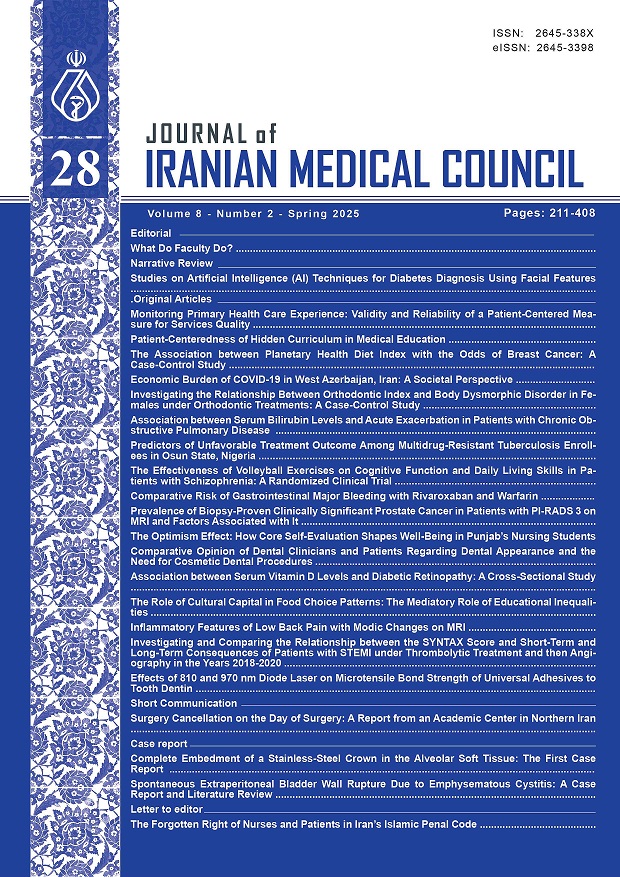
Document Type : Original article
Abstract
Background: The demand for orthodontic treatment to correct malocclusion has increased worldwide. A main cause of applying for orthodontics treatment may arise from mental disorders, such as Body Dysmorphic Disorder (BDD). This study aimed to investigate the relationship between BDD, the real need for orthodontic treatment based on the ICON index, and inquiry about orthodontics treatment in women.
Methods: In a case-control study, 414 women from the public outpatient dental clinic of Mashhad University of Medical Sciences, completed a demographic questionnaire, Beck Depression Inventory (BDI II), Beck Anxiety Inventory (BAI), and Yale-Brown Obsessive-Compulsive Scale Modified for BDD (BDD-YBOCS). A specialist also determined the ICON index for each participant.
Results: Among 414 subjects, 52 patients (31 in the orthodontics and 21 in the control group) (p=0.182) had a BDD-YBOCS score of 20 or above. The frequency of BDD, based on a definite diagnosis by an interview with a psychiatric specialist, was 6.28% among the orthodontic patients, which was significantly more than that of other dental patients (p<0.05). The mean ICON index score was found to have a significant difference between the orthodontic patients and the controls (p<0.001). No correlation was found between the severity of ICON and BDD-YBOCS scores in all the participants (p=0.804), in the cases (p=0.655), or the controls (p=0.403).
Conclusion: The current study found no correlation between ICON and BDD score. However, a significantly higher rate of BDD subjects receiving orthodontic procedures suggests using the BDD-YBOCS survey in dental clinics to screen patients suspected of having BDD for further psychological management.
Keywords: Anxiety, Body dysmorphic disorder, Control groups, Depression, Malocclusion, Outpatients
Introduction
In recent years, orthognathic surgeries and non-surgical facial aesthetic procedures have gained popularity in the dental community, especially in the orthodontics settings (1,2). One of the main challenges for clinicians in dentofacial aesthetics is that the perception of beauty can vary greatly among individuals and can be influenced by personal and subjective factors. The perception of body image is an important driving force in individuals who seek orthodontic treatments. Dentists are typically well-equipped to handle the cases with clinically significant dentofacial pathologies. In many cases, when a patient believes they need a procedure to improve their aesthetics, the clinician cannot verify that need through an objective lens. However, indices like the “Index of Complexity, Outcome, and Need” (ICON index) in orthodontics take into account not only objective measures of malocclusion, but also the influence of subjective beauty perspectives (3). However, a patient excessively focused on not clinically severe maxillofacial defects can challenge for the dentist. Therefore, dentists should be aware of the possibility of underlying psychological conditions, particularly Body Dysmorphic Disorder (BDD) (1,2,4-7).
BDD is a psychiatric disorder defined by an excessive and persistent preoccupation with an imagined or slight physical defect in appearance, which can cause significant distress and impair the patient’s functioning (8,9). BDD is now classified as one of the obsessive-compulsive disorders in the Diagnostic and Statistical Manual of Mental Disorders, 5th edition (DSM-5), since it is characterized by the repetitive behaviors or mental obsessions associated with concerns about beauty (8). Even though BDD preoccupations can involve any body part, the head and face are the most affected (4,10-12). Therefore, dentists, maxillofacial surgeons, and orthodontists are likely to encounter BDD patients. Since patients with BDD often hide their symptoms and are not aware of the root of their dissatisfaction, they may not seek appropriate psychiatric help (13) (14). Most BDD patients who seek cosmetic therapies have unrealistic expectations from the procedure results, may be dissatisfied with the outcome of their treatment, may resort to litigation afterward, and may frequently seek a variety of procedures (14,15). Furthermore, since BDD is strongly associated with an increased risk of anxiety-related and mood disorders (12), hospitalization, suicidal ideation, and behaviors (16,17), psychological assessment is crucial for the overall treatment of these patients (3).
A recent study has revealed that over 50% of patients seeking orthodontic treatment needed no treatment (18). Also, the BDD as well as orthodontic treatment rates is higher in women (19). However, only some studies have focused on the relationship between these factors in Iranian females. Therefore, the present study aimed to evaluate the relationship between BDD, the real need for orthodontic treatment based on the ICON index, and inquiry about orthodontics treatment in females.
Materials and Methods
Study design
This case-control study was conducted in the public outpatient dental clinics of Mashhad University of Medical Sciences. Faculty of Dentistry at Mashhad University of Medical Sciences, Mashhad, Iran. The study recruited 414 female aged between 18 and 35 between January 2019 and April 2020.
Inclusion and exclusion criteria
The sampling was based on the convenience method. All the subjects referred to the public outpatient dental clinics, Faculty of Dentistry at Mashhad University of Medical Sciences, Mashhad, Iran whotended to participate in the study during the interval time of the research, were recruited. Two hundred seven patients who attended an orthodontics clinic for cosmetic purposes participated in the study as the case group, and an equal number of individuals who visited other departments of dental clinics, such as prosthodontics, periodontics, or endodontics for non-cosmetic purposes, were selected as the control group.
Patients who needed surgical treatment and those with severe psychiatric disorders were excluded from the study.
Study procedure
Patients were addressed during their regular visits to the outpatient clinics. They were asked to complete a questionnaire that evaluated socio-demographic and clinical characteristics. We note that we used a translated Farsi version of the questionnaires, and its accuracy is validated in other works. After determining the ICON index, the participants completed the Beck Depression Inventory (BDI II), Beck Anxiety Inventory (BAI), and Yale-Brown Obsessive-Compulsive Scale Modified for Body Dysmorphic Disorder (BDD-YBOCS).
Measures and instruments
ICON index was considered for all the subjects by a specialist. All the participants completed the BDI II, BAI, and BDD-YBOCS.
Index of Complexity, Outcome, and Need
The CON index comprises five components that grade the malocclusion (3). The first section is the aesthetic component that the patient judges and scores based on the standard Index of Orthodontic Treatment Need (IOTN) beauty index (20). Then, the clinicians scored the patients separately for the four remaining sections of Upper Arch Crowding, Crossbite, Overbite, and Buccal Antero-posterior Relationship. Any discrepancies between the results were resolved by consensus. The resulting score is the occlusion state, calculated by multiplying each component by its respective weight factor and adding them together.
Yale-Brown Obsessive-Compulsive Scale Modified for Body Dysmorphic Disorder
The modified BDD-YBOCS is a self-assessed 12-item questionnaire that can potentially diagnose BDD. Phillips et al recommended a cut-off point of 20 or more for this purpose. Patients with a score of 20 or more in the BDD-YBOCS were referred to an expert psychiatrist to validate the clinical diagnosis using the DSM-5 criteria (21,22).
Beck Depression Inventory- Second Edition (BDI-II)
BDI-II is a revised version of the Beck Depression Inventory (BDI) designed to measure the severity of depression in adolescents and adult (23). Each questionnaire item is scored from 0 to 3, thus the total questionnaire ranges from 0 to 63. The proposed cutting points for this questionnaire are as follows: a score of 0-13 indicates no depression, mild depression 14-19, moderate depression 20-28, and a score of 29-63 indicates severe depression. The Cronbach’s alpha coefficient is 0.91, and the reliability coefficient is 0.94 in the Iranian population (24).
Beck Anxiety Inventory (BAI)
BAI is a self-assessment questionnaire with 21 statements that measure the general severity of anxiety. Each symptom scored through the four-degree scale: at all, it was mild (not very upset), moderate (very unpleasant but tolerated), and severe (I cannot tolerate it). Each item takes a score between 0 and 3. The total score is 0 to 63. The proposed cutting points are very low anxiety (0-21), and moderate anxiety, and scores higher than 36 indicate severe anxiety. The Cronbach’s alpha coefficient was 0.92. The psychometric properties of this inventory were reported as acceptable in the Iranian studies (25).
Sample size calculation
A previous study (26) reported a rate of 8.33 BDD for females under the orthodontic procedures and 2.86 for controls. Considering an alpha=0.05 and a beta=0.2, the sample size was calculated as 239 in each group. However, during the study, 207 subjects were recruited in each group, which has been noted as a study limitation.
Statistical analysis
The data was analyzed using IBM SPSS Statistics software version 16 (IBM Inc., Armonk, New York). Mean, standard deviation (S.D.), and frequency in the categorical variables are presented as continuous variables. Intergroup comparisons were conducted using the Chi-square test for binary variables and the student’s t-test for continuous variables. The Mann-Whitney U test was used for non-normal-distributed data. Pearson Correlation Coefficient was utilized to measure the linear correlation in normally distributed variables. Finally, p-values of ≤0.05 were regarded as statistically significant.
Ethical Approval and Consent to participate
The study was approved by the Ethical Committee of Mashhad University of Medical Sciences, Mashhad, Iran (920228). After explaining the purpose of the survey, all the participants signed an informed consent. Each subject was identified by a code to maintain the privacy.
Table 1. Demographic information of the case and control groups
|
Characteristics |
Orthodontic |
Non-Orthodontic |
p-value |
|
|
Mean+SD |
Mean+SD |
|
||
|
Age |
23.79+4.49 |
24.51+4.45 |
0.102 |
|
|
|
N(%) |
N(%) |
|
|
|
Marital status |
Single |
140(67.6) |
129(63.5) |
0.681 |
|
Married |
65(31.4) |
72(35.5) |
||
|
Widow/Divorced |
2(0.1) |
2(0.1) |
||
|
Education |
Under diploma |
4(1.9) |
6(2.9) |
0.891 |
|
Diploma & Associate |
90(43.5) |
91(44.0) |
||
|
Bachelor & Master |
110(53.1) |
106(51.2) |
||
|
Doctorate |
3(1.4) |
4(1.9) |
||
|
Income |
Family dependent |
130(64.0) |
136(67.3) |
0.435 |
|
Low |
20(9.9) |
26(12.9) |
||
|
Middle |
33(16.3) |
25(12.4) |
||
|
High |
20(9.9) |
15(7.4) |
||
Table 2. Comparison of the indices between orthodontic and non-orthodontic groups
|
Characteristics |
Orthodontic |
Non-Orthodontic |
p-value |
|
|
Mean+SD |
Mean+SD |
|
||
|
Body Dysmorphic Disorder (BDD) |
11.00+7.36 |
10.08+6.72 |
0.184 |
|
|
Index of Complexity, Outcome, and Need (ICON) |
29.64+16.96 |
21.58+12.68 |
<0.001 |
|
|
Beck Anxiety Inventory (BAI) |
10.94+8.580 |
12.05+8.794 |
0.163 |
|
|
Beck Depression Inventory- Second Edition (BDI-II) |
10.31+7.502 |
11.82+8.722 |
0.147 |
|
|
|
N(%) |
N(%) |
|
|
|
BDD |
<20 |
176(85.0) |
186(89.9) |
0.182 |
|
≥20 |
31(15.0) |
21(10.1) |
||
Table 3. Correlation between BDD and some indices (ICON, BAI, BDI-II, income, education and age) for orthodontic and non-orthodontic groups
|
Characteristics |
BDD |
|||||
|
Orthodontic |
Non- Orthodontic |
All |
||||
|
Correlation Coefficient |
p-value |
Correlation Coefficient |
p-value |
Correlation Coefficient |
p-value |
|
|
Index of Complexity, Outcome, and Need (ICON) |
-0.031 |
0.655 |
-0.059 |
0.403 |
0.012 |
0.804 |
|
Beck Anxiety Inventory (BAI) |
0.398 |
<0.001 |
0.393 |
<0.001 |
0.411 |
<0.001 |
|
Beck Depression Inventory- Second Edition (BDI-II) |
0.455 |
<0.001 |
0.488 |
<0.001 |
0.455 |
<0.001 |
|
Income |
-0.161 |
0.022 |
-0.068 |
0.335 |
0.080 |
0.585 |
|
Education |
-0.024 |
0.731 |
-0.132 |
0.058 |
-0.149 |
0.292 |
|
Age |
-0.047 |
0.508 |
-0.086 |
0.217 |
-0.071 |
0.149 |
Results
This study was performed on 414 women who attended the orthodontics clinic for cosmetic purposes (207 cases) or other departments of dental clinics for non-cosmetic purposes (207 controls). The mean age of the case and control groups was 23.79 with an S.D. of 4.49 and 24.51 with an S.D. of 4.45, respectively. Demographic information is summarized in table 1.
Among 414 participants, 52 patients had a score of 20 or higher on the BDD-YBOCS, which were 31 (15%) of cases in the orthodontics group and 21 (10.1%) subjects in the control group (p=0.182) (Table 2). Also, there was no significant difference between groups in the mean BDD-YBOCS (p=0.184). For a definitive diagnosis of BDD, patients with a BDD-YBOCS≥20 were referred to an expert psychiatrist. Of the 52 individuals, 13 did not agree to attend the interview, while 19 cases were diagnosed with BDD from the remaining 39 who underwent a psychiatric evaluation. Among the BDD patients, 13 belonged to the orthodontics group, and six were from the control group. Therefore, the prevalence of BDD was 6.28% and 2.89% among the orthodontic patients and other dental patients, respectively (p<0.05).
Moreover, BAI (p=0.163) and BDI-II (p=0.147) indicated no significant difference between the groups. However, the mean ICON index score (p<0.001) found a statistically significant difference between the orthodontics patients and controls.
When all the patients were categorized based on their BDD-YBOCS scores, the mean BAI and BDI-II scores were significantly higher in subjects with scores of ≥20 (p<0.001). However, amongst the participants with a BDD-YBOCS <20, orthodontics patients had a significantly lower mean score of BDI-II than their non-orthodontic counterparts (p=0.044).
No correlation was found between the severity of ICON and BDD-YBOCS scores in all the participants (p=0.804), cases (p=0.655), or controls (p=0.403). However, BAI and BDI-II scores showed significant correlations with BDD-YBOCS scores in all the categories (all p-values<0.001, Table 3). Also, a weak negative correlation (-0.161) was found between income and BDD in the orthodontic group (Table 3).
Discussion
The present study aimed to evaluate the relationship between BDD, the real need for orthodontic treatment based on the ICON index, and inquiry about orthodontics treatment in females. The findings demonstrated that among 414 participants, 31 (15%) individuals in orthodontics vs. 21 (10.1%) in the controls had BDD. No correlation was found between the severity of the malocclusion and BDD scores. Therefore, it could not be proven that patients who needed no corrective orthodontic procedures from a clinically objective perspective might have higher BDD-YBOCS scores. The frequency of BDD, based on a definite diagnosis by an interview with a psychiatric specialist, was 6.28% among the orthodontic patients, which was significantly more than that of other dental patients (p<0.05).
A frequency of 6.2% for BDD in the orthodontic applicants is in line with previous studies. A systematic review and meta-analysis reported a prevalence of 5.2% for BDD in those seeking Orthodontics/Cosmetic dentistry (27), and a recent 2021 meta-analysis found a prevalence of 6.2% (95%CI: 5.2-13%) (28), both of which had similar results in comparison with our findings (6.28%). Another study which diagnosed BDD by interviewing the participants, revealed a BDD prevalence rate of 7.5% among adult orthodontic patients and a rate of 2.86% in members of the public (26). In addition, Yassaei et al reported a 5.5% frequency rate in a sample of Iranian orthodontic patients (29), and Sathyanarayana et al recorded a 5.2% frequency rate of BDD among the orthodontic patients in India (30), using a similar self-reported BDD-YBOCS survey. These studies suggest that orthodontic patients are more likely to have BDD than the general population. However, it is important to note that Hepburn and Cunningham used an interview-based method for diagnosing BDD, whereas the latter studies used a self-reported questionnaire. According to the findings of the current study, the difference between the frequency rates shown by the clinical diagnosis of BDD and the BDD-YBOCS questionnaire confirms that a clinical examination through a complete psychiatric evaluation is required for patients who are suspected of this disorder, and BDD cannot be assumed nor fully diagnosed on the grounds of self-reported surveys. However, surveys and questionnaires can be practical screening tools for suspected patients.
Since ICON was an indicator of the severity of malocclusion and the need for orthodontic treatment (3), it was not surprising when the scores were higher among the orthodontic patients. In addition, as BDD patients tend to have an imagined or a slight defect with an excessive focus on the flaws, it was anticipated their ICON index would not be significantly different from other patients.
This study compares psychological factors associated with anxiety (BAI) and depression (BDI-II) in individuals with BDD-YBOCS scores of below and above 20. The results showed that as anxiety and depression increase, thus do the BDD-YBOCS scores, which means that the more dissatisfied a person is with their appearance, the more anxious they feel and the more prone they are to depression. However, no statistically significant differences between BAI and BDI-II in the two groups of attendance at orthodontic clinics and those at different dental clinics. In contrast, the previous study by Phillips et al indicated that BDD subjects had higher scores on depression, anxiety, and anger/hostility scales than controls (31). This suggests that anxiety and depression in individuals with BDD may be caused by a variety of factors, not just dental beauty concerns. Moreover, the findings arise from a comparison between two groups of dental problems that basically could induce anxiety due to pain or fear of dental treatment procedures. At the same time, Phillips et al investigated BDD patients against normal controls.
Some studies have indicated that BDD patients were younger than non-BDD individuals (29, 30); however, our findings showed no significant differences regarding age. Our results showed that marital status is unrelated to BDD frequency, while most studies state that BDD is more observed among single individuals (27,29-31). It was indicated that BDD could be found more frequently in lower-income adults. It is possible that individuals with financial or educational deficiencies may suffer from lower self-esteem and experience more anxiety and depression in their social lives; as a result, they may compensate by excessive sensitivity toward their appearance, which can further develop into BDD.
The present study focused on the female population as a group that has a greater desire for cosmetic and orthodontic surgeries and investigated the relationship between BDD, the real need for orthodontic treatment, depression, anxiety, and applying orthodontic treatment. However, some limitations should be illustrated. The results may not generalize to the common population, since the control group was recruited from those referred to the dental clinic. Moreover, not all the BDD subjects identified by the questionnaire participated in the clinical diagnosis of the disease. Also, the sample size was low to obtain a high statistical power. Future studies should pay attention to these points to reach precise results.
Conclusion
The present study revealed that the objective test of the ICON did not correlate with BDD. However, BDD is more prevalent in patients seeking orthodontic treatments. Based on these findings, it can be suggested that orthodontists screen patients during the first visit for BDD history. The BDD-YBOCS survey can be used as a screening tool in patients suspected of BDD while referring individuals with higher scores to psychiatrists for further clinical evaluations are advised.
Acknowledgement
The Data belongs to Mashhad University of Medical Sciences research council and would be available on request subjected to the current university regulations.
Conflict of Interest
The authors declare that they have no conflict of interest